
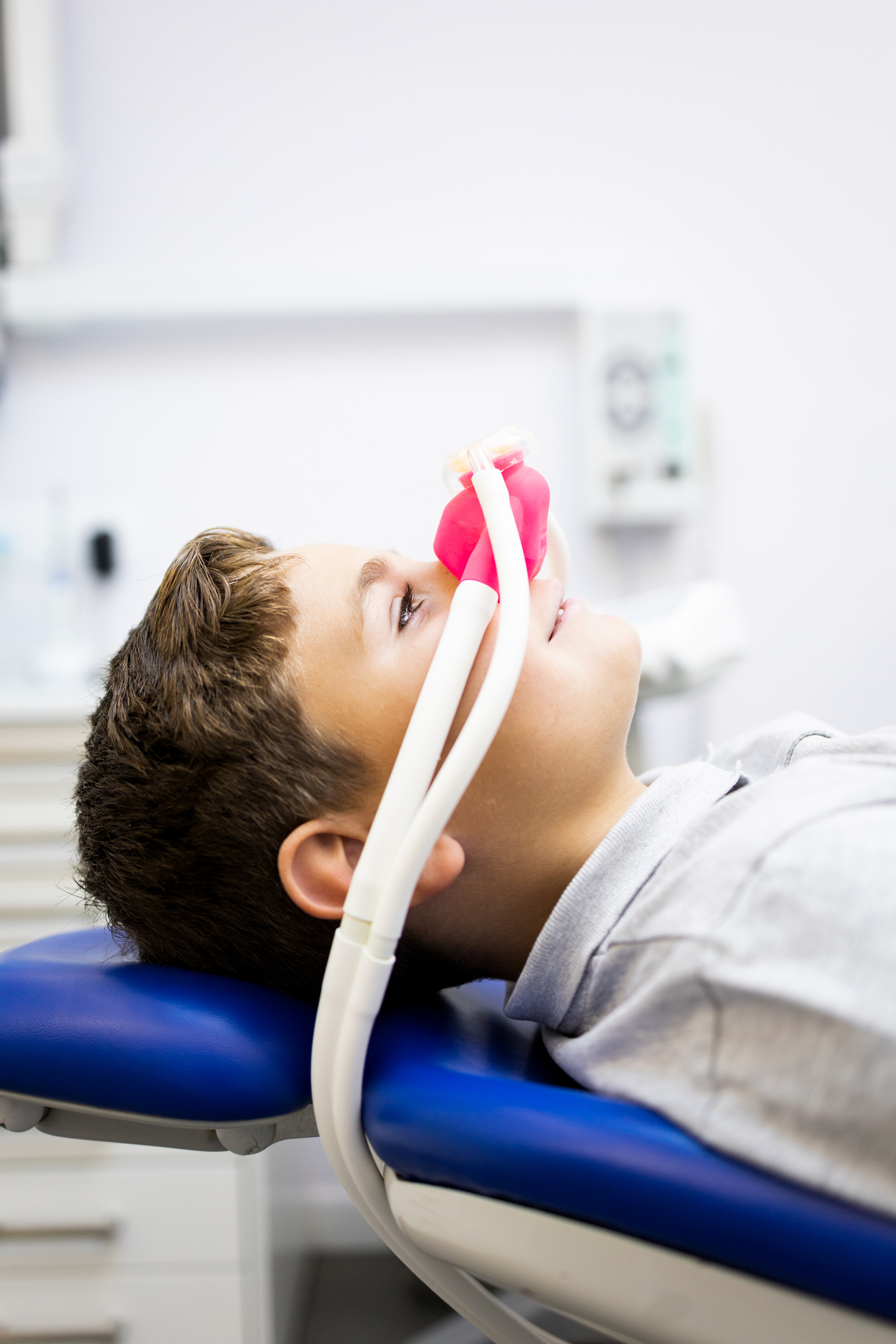
Dental nitrous oxide (laughing gas) is a mild, inhaled sedative that safely reduces anxiety while allowing you to remain completely conscious, coherent, and in control of your actions. Unlike the deeper sedation methods often seen in viral videos, laughing gas does not cause you to act erratically or reveal personal secrets.
Medical literature supports the absence of associations between variables such as age, sex, and treatment complexity [1] (Nelson et al., 2017). Many patients worry that sedation will strip away their social filter, causing them to accidentally reveal personal secrets or say something wildly inappropriate to the dental team. This fear is completely unfounded regarding laughing gas. Nitrous oxide works by temporarily binding to the anxiety receptors in your central nervous system. It does not interact with the frontal lobe, which is responsible for your personality, judgment, and social filters. Because your frontal lobe remains fully active, your identity and self-awareness stay completely intact. You will simply feel like a deeply relaxed version of yourself. You never have to worry about waking up and wondering what you confessed to our hygienists. Your secrets are entirely safe.
The term “laughing gas” is actually a bit of a historical misnomer. The nickname was coined over a century ago because the gas induces a mild sense of euphoria and well-being. However, it does not force you into fits of hysterical or uncontrollable laughter. If you are a professional who values a composed image, you do not need to worry about looking silly or acting foolish in the dental chair. While you might feel a pleasant mood boost or find a joke slightly funnier than usual, you will remain perfectly calm and composed. The most common physical reaction is not laughter, but simply a heavy, relaxed sigh as the tension leaves your jaw and shoulders.
A table that compares sedation truths
Sedation method | Risk of erratic behavior | Cognitive coherence | Memory retention | Maintenance and recovery |
Nitrous oxide | None | Fully alert | Full memory of the visit | Clears in 5 minutes |
Oral conscious sedation | Very low | Drowsy | High amnesia | 12-24 hours |
IV sedation | High | Unconscious or heavily impaired | Total amnesia | 24+ hours |
Clinical literature supports that nitrous oxide enhances the effect of local anesthetics, thereby helping achieve profound anesthesia [2] (Khinda et al., 2023). For patients with a history of medical trauma or high anxiety, the idea of having a mask placed over their nose can actually trigger feelings of claustrophobia. They fear that being “hooked up” to a machine will make them feel trapped, leading to a panic attack rather than relaxation. At St. Matthews Family Dental, we put the power back in your hands. The nasal hood we use is incredibly small and lightweight, resting gently only over your nose, leaving your mouth and eyes completely uncovered. More importantly, nitrous oxide is highly adjustable (a process called titration). If you ever feel overwhelmed or even slightly claustrophobic, you simply give us a hand signal. We can turn the gas down or remove the mask instantly. Knowing that you can stop the process at any second physically prevents the “trapped” feeling that fuels paranoia.
For professionals, confidentiality and professional image are important. A major myth surrounding dental sedation is the “sedation hangover,” the fear that you will leave the office with slurred speech, a droopy face, or a visible mental fog. Because nitrous oxide is an inert gas, your body does not metabolize it like a pill or liquid medication. Once we switch your airflow to 100% pure oxygen at the end of your visit, the gas is entirely flushed from your system in just five minutes. You will walk out of our Thierman Lane office with crystal-clear speech, perfect balance, and sharp cognitive focus. You can confidently walk straight into a boardroom presentation or a parent-teacher conference, and no one will ever know you just had dental work done.
Parents often see those viral videos of erratic teenagers and immediately worry about how their own child will react to laughing gas. Will they throw a tantrum? Will they be confused and crying when the appointment is over? The reality of pediatric laughing gas is incredibly peaceful. Because children do not carry the same complex social anxieties as adults, they tend to feel relaxed very quickly. In our office, we call it “magic air.” When a child breathes it in, they simply become highly cooperative, still, and calm. It lowers their sensory overload from the bright clinic lights and strange noises, allowing them to happily watch a movie on our ceiling monitors. Once the procedure is over, they bounce back instantly without any emotional mood swings, ready to head straight back to their classes at nearby St. Matthews schools.
Almost all viral “wisdom teeth” videos feature patients recovering from deep IV sedation or general anesthesia. Those deeper sedatives can cause temporary confusion, emotional outbursts, and memory loss as the brain wakes up. Nitrous oxide alone does not produce these erratic behavioral side effects.
Yes! Because nitrous oxide keeps you entirely coherent, you still have the fine motor skills and mental clarity to use your phone. While we usually recommend putting your phone away to fully enjoy the relaxation, you are completely capable of texting your family or listening to a podcast during your treatment.
Yes. Unlike oral conscious sedation (the “pill” method), which actively suppresses your short-term memory, nitrous oxide does not cause amnesia. You will remember the sights and sounds of your appointment, but without the physiological panic or anxiety you might normally associate with them.
[1] Nelson, T. M., Griffith, T. M., Lane, K. J., Thikkurissy, S., & Scott, J. M. (2017). Temperament as a Predictor of Nitrous Oxide Inhalation Sedation Success. Anesthesia progress, 64(1), 17–21. https://doi.org/10.2344/anpr-63-03-01
[2] Khinda, V., Rao, D., & Sodhi, S. P. S. (2023). Nitrous Oxide Inhalation Sedation Rapid Analgesia in Dentistry: An Overview of Technique, Objectives, Indications, Advantages, Monitoring, and Safety Profile. International journal of clinical pediatric dentistry, 16(1), 131–138. https://doi.org/10.5005/jp-journals-10005-1807