
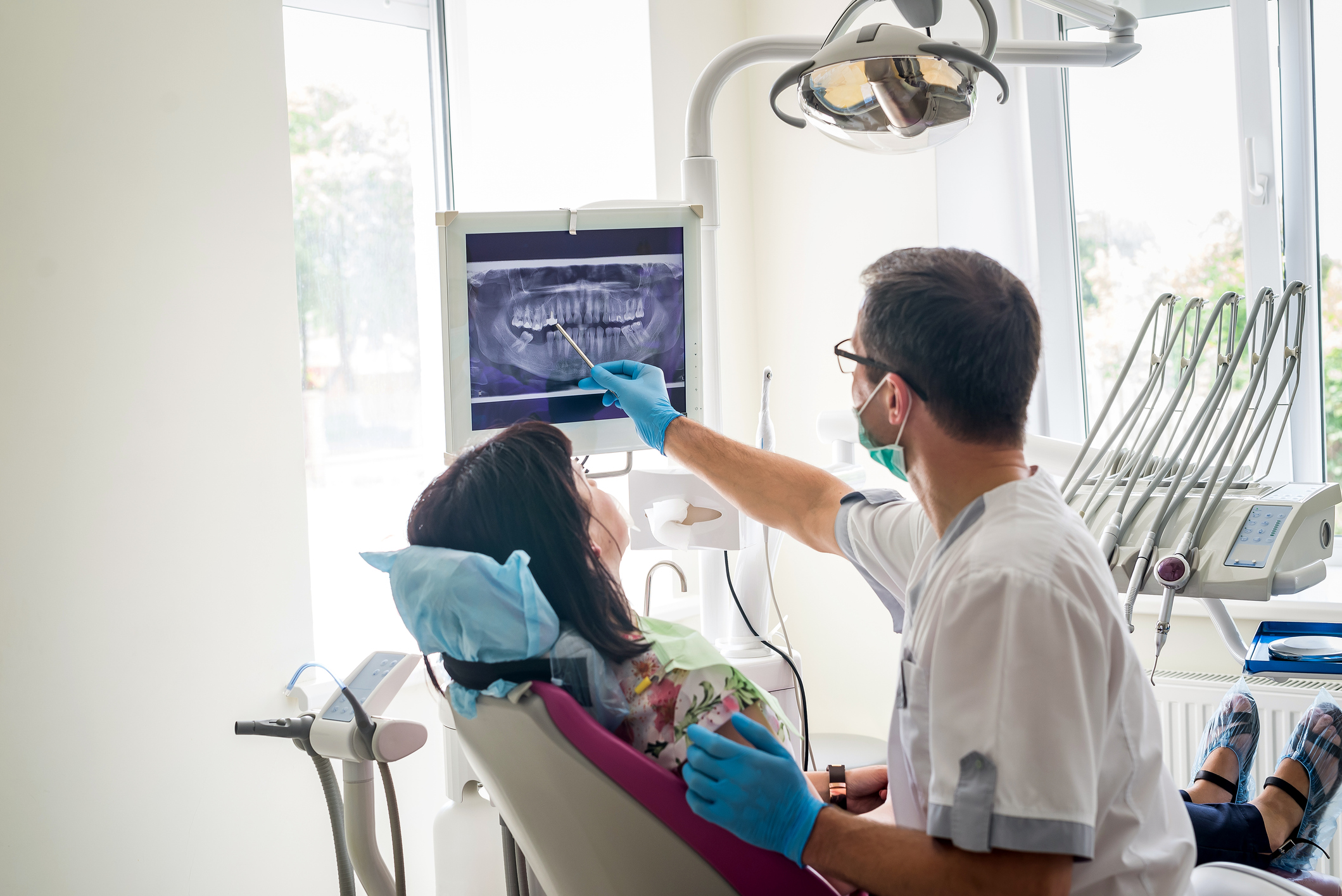
Under most Guardian dental insurance plans, routine diagnostic imaging is covered at 100% as a preventive service. This means you will typically pay zero out-of-pocket costs when visiting an in-network provider like St. Matthews Family Dental for your annual low-radiation digital X-rays.
If you recently moved or are simply looking for a new dental home, you might wonder what happens if you already had X-rays taken this year. Because Guardian typically strictly enforces their “once every 12 months” rule for preventive bitewing X-rays, taking a new set right away might result in an out-of-pocket charge. If you have high-quality, recent digital X-rays from your previous dentist, administrative teams can help you legally transfer those records to the offices. This simple step serves two great purposes: it ensures you do not waste your Guardian insurance benefits by triggering a denial, and it perfectly aligns with the dental philosophy of minimizing your exposure to radiation.
Medical literature supports the use of dental X-rays to examine the oral cavity in areas that otherwise cannot be seen [1] (Mark, 2024). Many patients assume that dental X-rays are only used to hunt for cavities. While spotting early decay between your teeth is crucial, dentists rely on high-resolution digital imaging to monitor the entire structural foundation of your mouth. Because digital sensors provide such incredible clarity, dentists can magnify images on a screen to detect invisible threats that a visual exam cannot catch. This includes:
By utilizing your Guardian benefits for these scans, you allow your dental team to protect your overall wellness, not just your tooth enamel.
A table that compares diagnostic imaging under Guardian Insurance
Feature | Traditional X-rays | Bitewing X-rays | Panoramic digital scan |
Guardian coverage | 100% | 100% | 100% |
Radiation level | Moderate to high | Ultra-low | Low |
Diagnostic focus | General decay | Early cavity detection | Jawbone, roots, and wisdom teeth |
Patient comfort | Sharp edges | Smooth, rounded digital sensors | External scan |
Result speed | 5-10 minutes | Instant | Instant |
Dental insurance can sometimes feel like a maze, and occasionally, a claim for a necessary diagnostic X-ray might be delayed or denied by Guardian. This usually happens due to a simple coding error, a frequency limit, or a request for more information. If this happens, you are not on your own. Insurance coordinators act as your personal financial advocates. If a targeted X-ray is denied, the dental team will automatically submit a “Clinical Narrative.” This is a detailed explanation from dentists, backed by your digital records, that proves to Guardian the X-ray was medically necessary to treat your pain or infection. Most dental offices fight the administrative battles so you can focus on your health.
Medical literature supports the use of intraoral scanners as advanced devices for capturing precise 3D images of the oral cavity [2] (Dhull et al., 2024). While Guardian is excellent at fully covering routine 2D bitewing and panoramic X-rays under your preventive tier, advanced 3D imaging requires a different approach. Sometimes, if you need a complex tooth extraction, you may be recommended a CBCT (Cone Beam Computed Tomography) scan to see a 360-degree view of your nerves and jawbone. It is important to know that Guardian often classifies 3D scans differently from standard preventive X-rays. Depending on your specific employer-sponsored plan, a 3D scan might be classified as a “diagnostic/basic” service rather than “preventive,” meaning it could require a small co-pay.
For professionals managing a household budget, skipping a dental checkup might seem like an easy way to save time. However, skipping your annual X-rays is one of the most expensive financial mistakes you can make. Your Guardian plan essentially pre-pays for these diagnostic images. When you skip your appointment, you leave free healthcare on the table. More importantly, dental decay never heals on its own; it only migrates deeper into your tooth. If your dentist catches a tiny shadow on your covered X-ray today, it can usually be fixed with a simple, inexpensive filling. If you skip that X-ray and wait until the tooth starts hurting a year later, that exact same cavity will likely require a $1,500 crown or a complex root canal. Using your free Guardian X-rays today is your ultimate shield against the high costs of emergency dental surgery tomorrow.
Under most standard Guardian PPO plans, routine bitewing X-rays (used to find cavities between your teeth) are fully covered once every 12 months.
Absolutely. Because dentists use digital sensors, the radiation exposure is incredibly low, often less than what you experience on a short airplane flight. It is the safest way to ensure that your child’s adult teeth develop correctly.
If you experience a dental emergency, Guardian typically covers targeted, problem-focused X-rays.
[1] Mark, A. M. (2024). The value of dental x-rays. The Journal of the American Dental Association, 155(4), 356–356. https://doi.org/10.1016/j.adaj.2024.02.001
[2] Dhull, K. S., Nagar, R., Mathur, P., Shil, M., Jain, S., Dureha, R., & Kapoor, A. (2024). Intraoral Scanners: Mechanism, Applications, Advantages, and Limitations. Journal of pharmacy & bioallied sciences, 16(Suppl 3), S1929–S1931. https://doi.org/10.4103/jpbs.jpbs_1299_23