
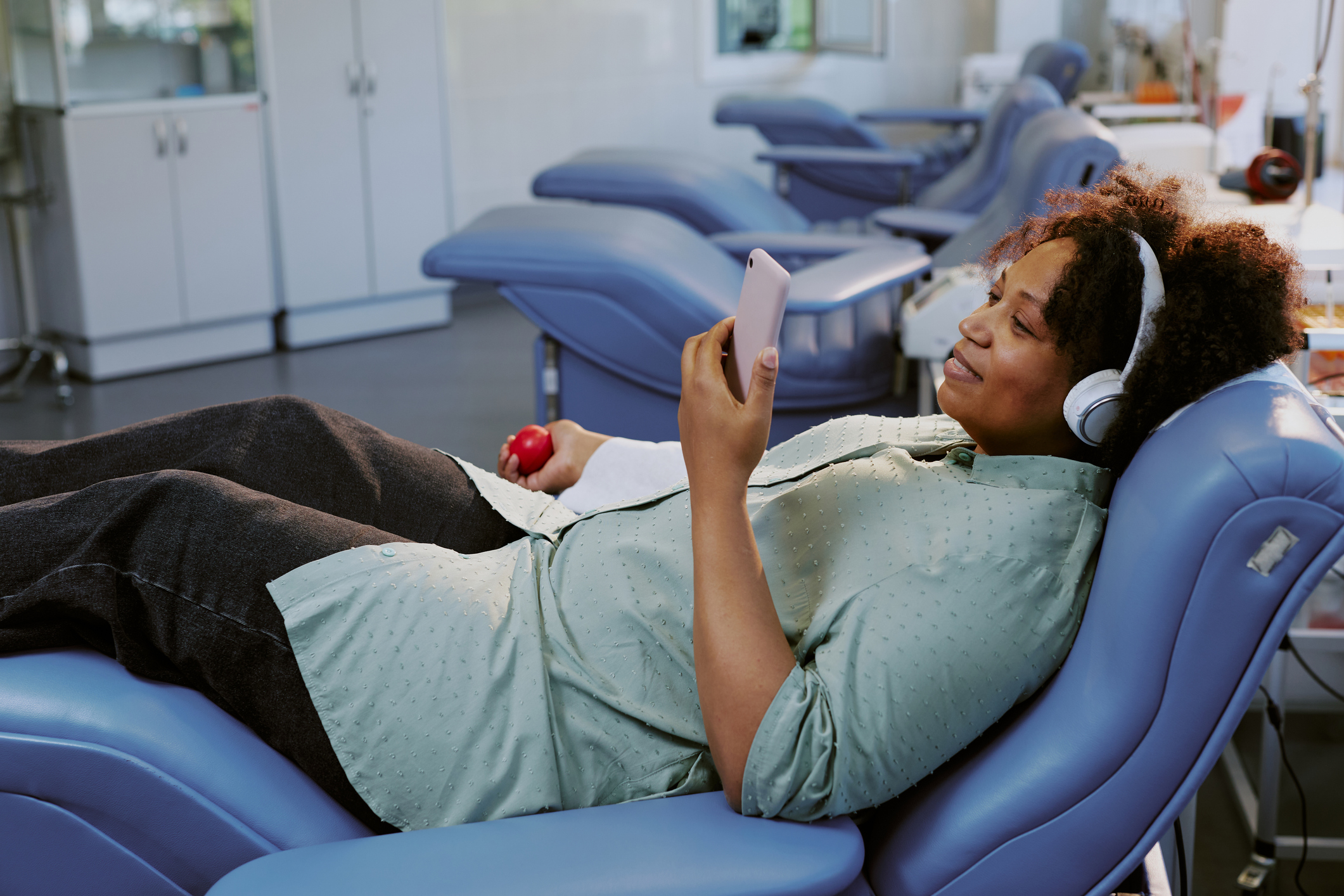
Distraction therapy at St. Matthews Family Dental is a non-pharmacological comfort technique that uses acoustic and visual engagement to redirect a patient’s attention away from clinical sights and sounds. By utilizing noise-canceling headphones, personalized music, and ceiling monitors, dentists actively lower your sensory awareness to create a relaxing, stress-free clinical environment.
Clinical literature suggests that sound control in the dental office will enhance communication, feelings of safety, and relaxation across all age groups [2] (Antoniadou et al., 2022). Putting on a pair of headphones at the dentist actually changes how your brain processes the appointment. This is rooted in a neurological concept called cognitive bandwidth. Your brain can only process a limited amount of sensory information at one time. When you actively listen to an engaging true-crime podcast, a compelling audiobook, or your favorite high-energy playlist, you are forcing your brain’s auditory cortex to focus on that specific media. Because your attention is locked onto the story or the music, your brain has less capacity to process the ambient sounds of the clinic. This acoustic masking lowers your body’s stress response, naturally slowing your heart rate and keeping you in a calm, resting state without the need for chemical sedatives.
To get the most benefit from distraction therapy, we highly recommend bringing a personalized “Comfort Kit” to your next appointment. Here is exactly what you should pack:
Feature | Distraction therapy | Nitrous oxide | Oral conscious sedation |
Cost | $0 | Low | Moderate investment |
Primary mechanism | Sensory reduction | Central nervous system relaxant | Deep brain relaxation |
Recovery time | None | 5 minutes | 12-24 hours |
Memory of the visit | Yes | Yes | Memory suppression |
Best used for | Cleanings, mild anxiety | Restorative work | Complex surgery |
If you are a professional looking for the ultimate modern dental experience, combining distraction therapy with our needle-free technology is the answer. As noted in our other guides, St. Matthews Family Dental utilizes advanced Air Abrasion to fix small cavities without the friction, heat, or vibration of a traditional dental drill. While Air Abrasion is practically painless, it does produce a soft “whooshing” sound of compressed air. By putting on your headphones and listening to a curated playlist, you completely mask that sound. The combination of needle-free clinical technology and acoustic distraction means you can get a cavity filled without ever feeling a pinch or hearing a drill. You simply lie back, listen to your music, and walk out with a restored smile.
It is a well-known fact in healthcare: the most expensive dental bill is the one caused by avoidance. When the sensory triggers of a dental office cause you to skip your appointments, microscopic cavities go undetected. Within a year, a tiny problem that could have been fixed with a simple filling migrates deep into the tooth, requiring a $1,500 porcelain crown or an expensive root canal. Distraction therapy is your financial shield. By intentionally making your dental visits comfortable and entertaining, we remove the psychological barrier to care. When you actually look forward to catching up on a Netflix show while you clean, you are far more likely to stay consistent with your preventive visits. This consistency allows our team to catch and treat issues early, saving you thousands of dollars in emergency restorative work and keeping your healthcare budget right on track.
Absolutely. We highly encourage you to bring your smartphone and your preferred headphones or AirPods. Listening to your own music, audiobooks, or podcasts is one of the most effective ways to block out clinical sounds and make your appointment fly by.
Before you put your headphones on, our dentists or your hygienist will explain exactly what we will do. We rely on a simple system of taps and hand signals to communicate with you while your music is playing.
If you find that acoustic distraction is not quite enough to stop your anxiety, we can easily pair your music with our pharmacological options. You can listen to your favorite playlist while utilizing Nitrous Oxide (laughing gas) to achieve a state of total, worry-free relaxation.
[1] Khandelwal, M., Shetty, R. M., & Rath, S. (2019). Effectiveness of Distraction Techniques in Managing Pediatric Dental Patients. International journal of clinical pediatric dentistry, 12(1), 18–24. https://doi.org/10.5005/jp-journals-10005-1582 https://doi.org/10.5005/jp-journals-10005-1582
[2] Antoniadou, M., Tziovara, P., & Antoniadou, C. (2022). The Effect of Sound in the Dental Office: Practices and Recommendations for Quality Assurance-A Narrative Review. Dentistry journal, 10(12), 228. https://doi.org/10.3390/dj10120228