
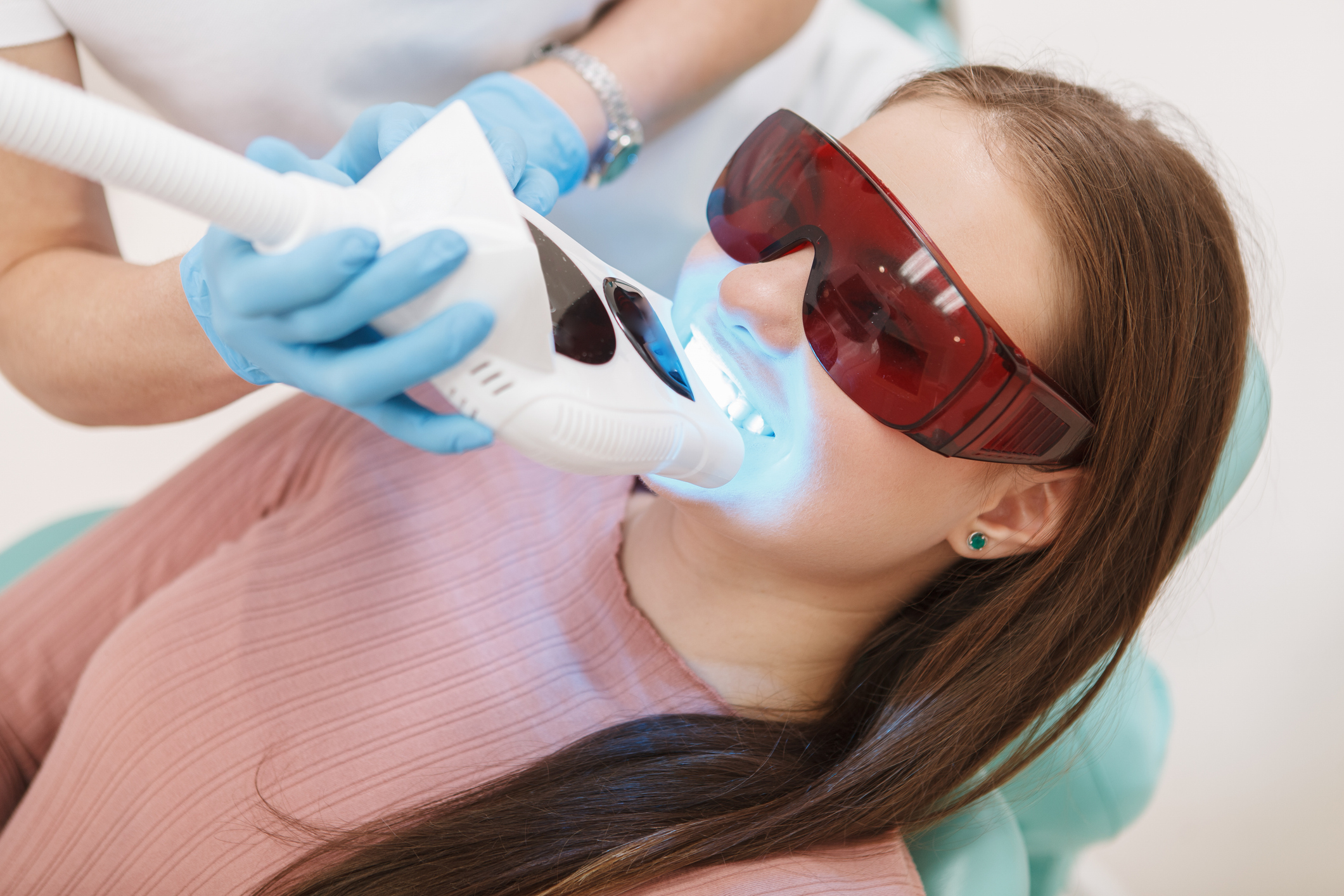
Does dental insurance cover teeth whitening? Typically, no. Because teeth whitening is classified as a purely cosmetic and elective procedure, standard dental insurance plans do not cover the cost. Patients at St. Matthews Family Dental can expect to pay a transparent cash-pay rate between $300 and $650 for professional whitening.
Even though your dental insurance will not cover the whitening gel, you absolutely need it to prep your smile. You cannot effectively whiten your teeth through layers of plaque, biofilm, or hardened tartar. If you try, you will end up with “window-pane whitening,” where the tooth looks bright in some spots and dark yellow where the tartar blocked the gel. Before you spend a single dollar out-of-pocket on cosmetic bleaching, use your PPO benefits. Most Delta Dental, MetLife, and Cigna plans cover 100% of your routine preventive cleaning (ADA Code D1110). By scheduling a fully covered prophylaxis at our St. Matthews office first, our hygienists will mechanically remove the surface stains and calculus. This creates a perfectly clean, porous canvas so your cash-pay whitening treatment delivers the brightest possible return on your investment.
One of the biggest financial mistakes patients make is mixing up the timeline of their dental work. For example: Consider you have a fractured tooth, and your insurance covers 50% of a major restorative porcelain crown. Dental porcelain is virtually stain-proof, but that also means it cannot be bleached. The color of your crown is permanent. If you get the crown first and decide to whiten your teeth a year later, your natural teeth will brighten, but your crown will stay dark, leaving you with a mismatched smile. The golden rule of cosmetic dentistry is to always do your out-of-pocket whitening first. Once you achieve your target shade, Dr. Higdon will use a precise shade guide so the dental lab can match your new, insurance-covered crown perfectly to your newly brightened enamel.
Table that compares whitening and cosmetic alternatives
Treatment type | Insurance coverage | Estimated cash cost | Durability | Maintenance level |
Professional whitening | 0% | $300-650 | 12-24 months | Low |
OTC whitening strips | 0% | Low | 1-3 months | High |
Porcelain veneers | 0% | $1000 per tooth | 10-15 years | Low |
Tooth colored fillings | 50-80% | Varies by plan | 7-10 years | Standard |
When patients realize that insurance will not cover their whitening, they often consider $40 over-the-counter (OTC) drugstore strips. However, these OTC whitening strips often end up costing you more in the long run. OTC strips are one-size-fits-all, meaning they rarely cover the curves of your unique smile and frequently leak bleaching chemicals directly onto your delicate gum tissue. At the dental office, your $300 to $650 investment pays for precision. Instead of messy putty, we use high-speed digital intraoral scanners to map your mouth in 3D. This allows us to fabricate a seal-tight, custom whitening tray that fits like a second skin. This medical-grade fit ensures the 25% to 40% hydrogen peroxide gel stays exactly on the tooth structure. You get a faster, perfectly even result that outlasts drugstore boxes by years.
Medical literature supports that bleaching is an effective treatment for changing the color of the teeth [1] (Butera et al., 2024). A common fear that keeps patients from investing in a brighter smile is the sharp “zinging” pain associated with whitening. Because teeth whitening is an elective procedure, you will not be using insurance-covered localized anesthetics. Our professional whitening protocol is specifically engineered to protect your dental nerves. Unlike generic strips, our professional gels are formulated with potassium nitrate and fluoride. These active ingredients work simultaneously to lift deep stains while actively blocking the microscopic pathways to the tooth’s nerve center. If you have a history of sensitive teeth, we can easily adjust the concentration of your gel, ensuring your path to a brilliant smile is entirely comfortable and stress-free.
When you pay out-of-pocket for cosmetic dentistry, you want those results to last as long as possible. Immediately after a professional whitening session, your enamel pores remain slightly open and hydrated for about 48 hours. During this critical window, your teeth act like sponges, making them highly susceptible to re-staining. To protect your financial investment, you must follow the “White Diet” for two days. Skip the dark bourbon, the colorful cocktails, and the morning cup of dark roast. Stick to white and clear foods like chicken, cauliflower, and pasta with white sauce. By giving your enamel 48 hours to lock in the new shade, your smile will stay brilliant for 12 to 24 months.
No. While Health Savings Accounts (HSAs) and Flexible Spending Accounts (FSAs) are incredible tools for covering dental deductibles and restorative work, the IRS explicitly excludes purely cosmetic procedures. You cannot use pre-tax funds for teeth whitening.
Unfortunately, no. Even if your intrinsic staining was caused by medical treatments or childhood medications (such as tetracycline), insurance providers still categorize the bleaching process as elective and will not cover it.
Yes! If you have active decay that requires a filling, most modern insurance plans will cover 50% to 80% of a tooth-colored composite filling. We always recommend doing your out-of-pocket whitening first, so we can shade-match your insurance-covered filling to your brand-new, brighter smile.
[1] Butera A, Maiorani C, Rederiene G, Checchi S, Nardi GM. Evaluation of the Effectiveness of Different Types of Professional Tooth Whitening: A Systematic Review. Bioengineering (Basel). 2024;11(12):1178. Published 2024 Nov 21. doi:10.3390/bioengineering11121178