
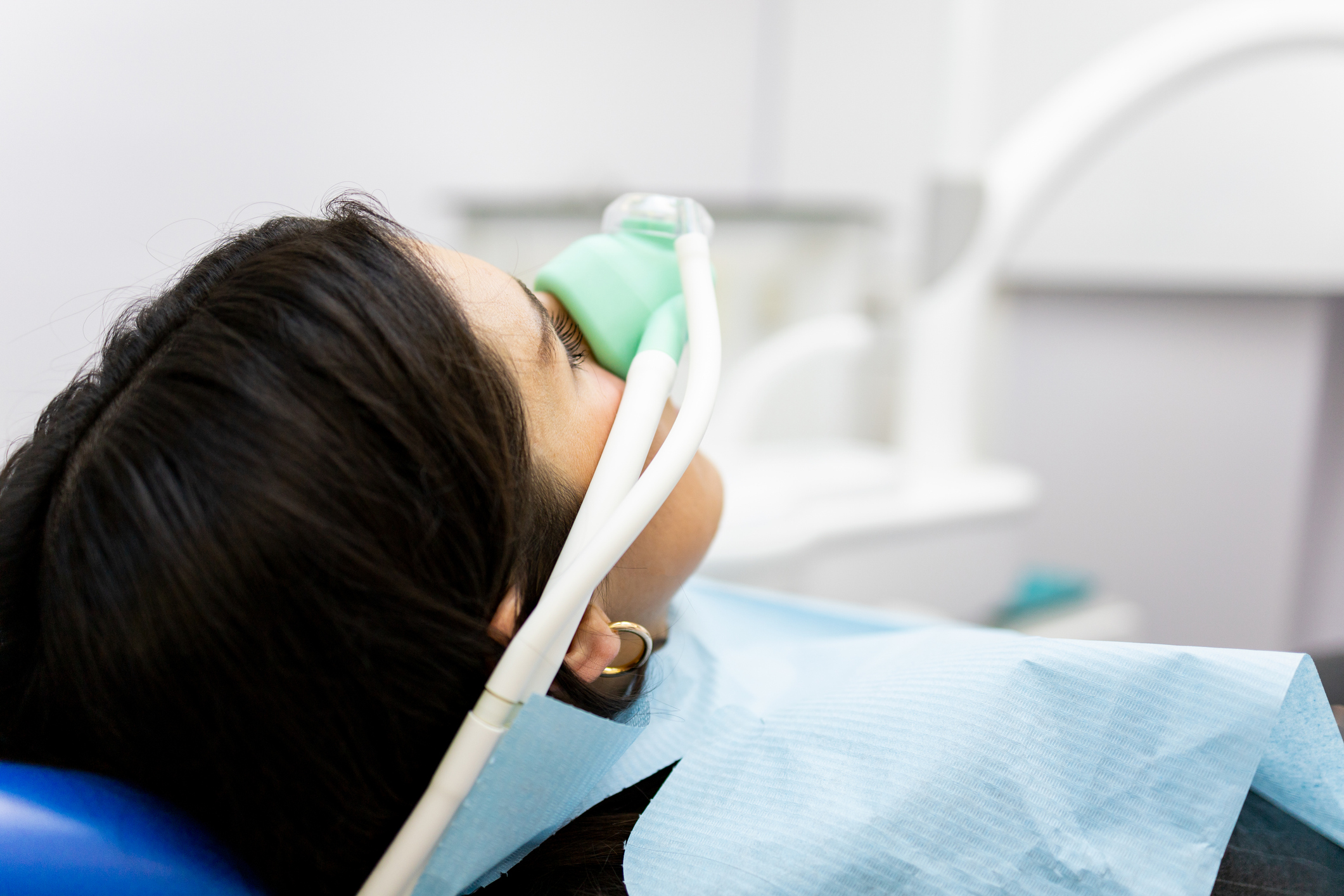
Sedation and sleep dentistry are two different approaches to managing patients’ anxiety and awareness in the dental chair. At St. Matthews Family Dental, both oral conscious sedation and nitrous oxide sedation are offered to help patients achieve comfort during dental procedures. With ‘Sedation Dentistry’, patients reach a conscious state of relaxation either through nitrous oxide inhalation or by oral medications. On the contrary, ‘Sleep Dentistry’ generally refers to general anesthesia, where patients are fully unconscious and need assistance breathing.
Medical literature indicates that conscious sedation is a technique whereby patients undergo a drug-induced depression of their consciousness but retain the ability to self-ventilate, maintain protective reflexes, and respond to verbal or light-pressure stimuli [1] (Bean et al., 2023). At St. Matthews Family Dental, we utilize this to lower your anxiety levels and suppress your gag reflex. You will remain able to follow the doctor’s instructions, while your social awareness feels distant and insignificant. Because you stay conscious, you are able to maintain your own natural reflexes, such as breathing and swallowing, making this the safer option for healthy patients compared to general anesthesia.
The main difference between sedation and general anesthesia comes down to the level of awareness. Conscious sedation is usually performed in dental practices. General anesthesia (GA) often requires the use of an operating room in a hospital setting, an anesthesiologist, and airway assistance using a breathing tube. The medical literature states that the most common indications for sedation or GA include mental or psychological disorders that impede patient cooperation, multiple comorbidities, cases of jaw surgery requiring complex and prolonged procedures, pediatric patients, and individuals with autism [2] (Catak et al., 2025). Ultimately, choosing between sedation and general anesthesia comes down to the patient’s health history, procedure complexity, and the level of consciousness that needs to be achieved.
Finding the right level of comfort starts with a conversation about your health and your goals. Clinical literature indicates that nitrous oxide is characterized by a rapid onset of less than half a minute and clearance within 1 minute, thus allowing for safe sedation and relatively rapid recovery when the procedure is completed [3] (Yang et al.,2024). Oral conscious sedation is better suited for those who want the appointment to feel like it flew by with little sense of time. General anesthesia requires a detailed pre-procedure health screening and a longer recovery window period following the procedure. At St. Matthew’s Family Dental, heart rate, oxygen levels, and blood pressure are monitored regularly throughout every sedated appointment, ensuring safety remains a primary goal regardless of sedation depth.
Comparing types of sedation and anesthesia in dental practice
Type of Anesthesia | Nitrous Oxide (Laughing Gas) | Oral Conscious Sedation | General Anesthesia (Sleep) |
Consciousness | Fully awake | Twilight sleep (relaxed) | Fully unconscious |
Responsiveness | High | Follows instructions | None |
Memory | Full memory | Little to no memory | No memory |
Breathing | Natural | Natural | Assisted (intubation) |
Recovery | 5 minutes | 12-24 hours | 24-48 hrs |
Best for | Cleanings/Restorative work/Extractions/ Root Canal Treatment (Anxious patients) | Restorative Treatment / Extractions/Root Canal Treatment (Severe dental anxiety/ long complex procedures) | Major surgical procedures |
Conscious sedation is the more cost-effective choice. General anesthesia typically includes additional facility fees and expenses for an anesthesiologist. Choosing conscious sedation at St. Matthews Family Dental, these extra costs are avoided. Through our major Louisville employers, you are able to understand your PPO insurance coverage. If you are uninsured, our Dental Savings Plan offers transparent, discounted rates to ensure you do not have to choose between your finances and your comfort.
No. During conscious sedation, you are naturally breathing on your own. Assisted breathing is utilized for general anesthesia only.
Yes. During sedation appointments, you will be responsive to our team’s instructions while having a sense of calmness.
Technically, conscious sedation is viewed as the safer option since the patient can breathe on their own and be responsive. We monitor your vitals, including oxygen and heart rate, throughout your visit to keep you in a perfect state of calm while sedated.
[1] Çatak, T., Mutlu, Ş. N., Saltalı, A. Ö., & Fidancıoğlu, Y. D. (2025). General anesthesia in dental treatments: where and how? BMC Oral Health, 25(1). https://doi.org/10.1186/s12903-025-06638-3
[2] Bean, T., & Aruede, G. (2023). Conscious Sedation in Dentistry. PubMed; StatPearls Publishing. https://www.ncbi.nlm.nih.gov/books/NBK592406/
[3] Yang, R., Zhao, R., Chaudry, F., Wang, T., Brunton, P., Khurshid, Z., & Ratnayake, J. (2024). Modern sedative agents and techniques used in dentistry for patients with special needs: A review. Journal of Taibah University Medical Sciences, 19(1), 153–163. https://doi.org/10.1016/j.jtumed.2023.10.004