
Sedation dentistry helps address a hypersensitive gag reflex by using nitrous oxide to depress the central nervous system and relax the muscles of the throat. This approach at St. Matthew’s Family Dental prevents muscle contractions, allowing patients to comfortably complete dental X-rays and cleanings without physical distress.
When a dental assistant places a digital X-ray sensor inside your mouth, it often brushes against the posterior third of your tongue. For patients with a hypersensitive gag reflex, this minor contact is perceived as a choking hazard. Your glossopharyngeal nerve instantly sends a survival signal, causing your throat muscles to contract. This is not a psychological weakness; it is an overactive biological defense mechanism. However, the resulting panic makes it physically impossible to hold the sensor still. Many patients feel immense embarrassment when they cannot complete a simple diagnostic scan. Understanding that this is a neurological reflex is the first step to overcoming it. We treat the reflex as a medical condition that requires a pharmacological solution. In addition, Medical literature supports that there is promise for managing gagging among dental patients with psychological techniques (O’Donald et al., 2025).
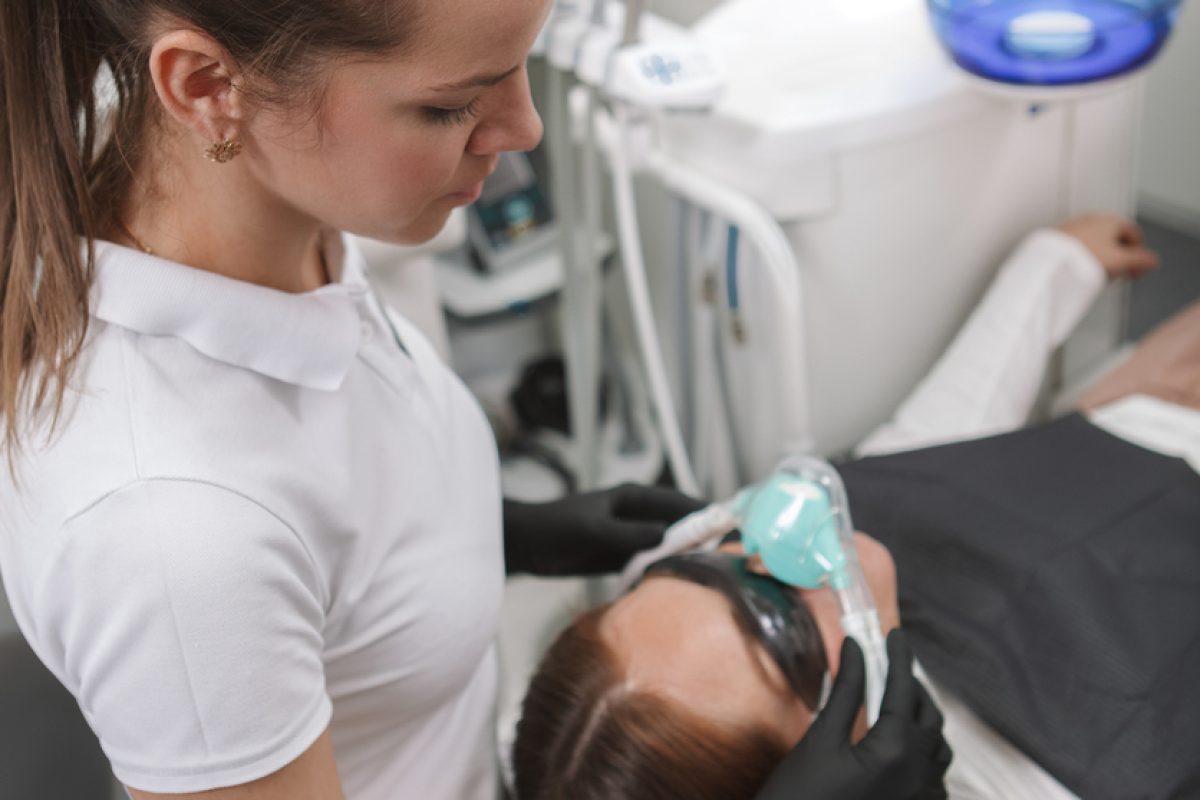
The secret to suppressing the gag reflex during an X-ray lies in how you breathe. When panic sets in, your natural instinct is to take short, quick breaths through your mouth. Mouth breathing dries out your soft palate and severely amplifies the gag trigger. Nitrous oxide sedation fundamentally changes this mechanical process. Because the sedative gas is delivered through a small, comfortable hood resting on your nose, you are forced to transition to rhythmic nasal breathing. When you breathe steadily through your nose, your soft palate naturally drops and seals off the back of your throat. This physical barrier essentially “hides” your gag trigger zones from the X-ray sensor. Combined with the deep, warm relaxation provided by the sedative, your body forgets to panic, allowing the X-ray to be captured in seconds.
A table that compares gag reflex management
Feature | Nitrous oxide sedation | Over-the-counter numbing spray | Deep IV sedation |
Primary target | Central nervous system | Surface tissue | Complete unconsciousness |
Effectiveness | High | Low to moderate | Maximum |
Recovery time | Fast | Moderate | Low |
Can you drive? | Yes | Yes | No |
Cost | Low to moderate | Very low | High |
Technology alone cannot cure dental anxiety; it requires a compassionate clinician. Dr. Nikki Bevilacqua has engineered a trauma-informed diagnostic protocol specifically for patients who have suffered through gag-inducing appointments in the past. Her approach removes the sensory triggers that lead to panic. First, our team uses modern digital X-ray sensors that feature rounded, smooth edges, which are much less abrasive than old-fashioned cardboard bite wings. Second, Dr. Bevilacqua utilizes a “front-to-back” sequencing method. By capturing images of your front teeth first, she helps build your confidence. By the time the sensor reaches the sensitive molar area, the nitrous oxide has reached peak efficacy, and your nervous system is completely relaxed. Most importantly, you are given a “stop signal.” If you raise your left hand, all movement stops instantly. This shift in power keeps you grounded and in total control.
For the Preventive Planner managing a household budget, avoiding X-rays due to a gag reflex is a costly gamble. Visual exams simply cannot detect decay hiding between your teeth or infections forming beneath the gumline. When these hidden issues are ignored, they migrate deep into the tooth structure. This creates a dangerous cycle of dental neglect. A microscopic cavity that could have been fixed with a quick, $200 tooth-colored filling can quietly evolve into a painful infection requiring a $1,500 root canal and crown. By investing a small, flat fee to add nitrous oxide sedation to your diagnostic visit, you empower our team to catch these issues early. Ultimately, paying for the comfort of sedation today protects your wallet from massive reconstructive bills tomorrow.
Setting yourself up for a successful, gag-free appointment starts before you even arrive at our Thierman Lane office. Because nitrous oxide relies on your ability to breathe through your nose, your nasal passages need to be clear. If you are battling the infamous allergy season, we recommend taking your preferred over-the-counter decongestant a few hours before your visit to ensure smooth, easy breathing. Additionally, while you do not need to fast for nitrous oxide, we highly recommend eating only a light snack beforehand. Clinical evidence suggests that nitrous oxide sedation has been the primary technique in the management of dental anxiety and fear (Khinda et al., 2023). A very heavy meal at a restaurant right before your appointment can occasionally cause mild nausea when combined with a sensitive gag reflex. By arriving with a settled stomach, clear sinuses, and the knowledge that Dr. Bevilacqua is completely focused on your comfort, you can finally enjoy a stress-free, tear-free dental visit.
Absolutely. Many of our patients only struggle with the placement of the X-ray sensor. We can administer nitrous oxide for the first ten minutes of your appointment to capture the necessary images, perform the 5-minute oxygen flush, and then complete your standard cleaning without any sedation.
While nitrous oxide is highly effective, you are always in control. If you feel a trigger building, you simply use your pre-established hand signal. Dr. Bevilacqua will immediately remove the instrument, allow you to take a sip of water, and wait until you are fully ready to proceed.
It is almost always a combination of both. Past trauma or anxiety about gagging actually causes you to tense your throat muscles and breathe through your mouth, which physically makes the reflex worse. Sedation addresses both the mental anxiety and the physical muscle tension simultaneously.
[1] O’Donald, F., Smith, M., Sevier-Guy, L. J., & Heffernan, A. (2025). Psychological interventions for gagging: Implications for dental practice. Special care in dentistry : official publication of the American Association of Hospital Dentists, the Academy of Dentistry for the Handicapped, and the American Society for Geriatric Dentistry, 45(1), e13090. https://doi.org/10.1111/scd.13090
[2] Khinda, V., Rao, D., & Sodhi, S. P. S. (2023). Nitrous Oxide Inhalation Sedation Rapid Analgesia in Dentistry: An Overview of Technique, Objectives, Indications, Advantages, Monitoring, and Safety Profile. International journal of clinical pediatric dentistry, 16(1), 131–138. https://doi.org/10.5005/jp-journals-10005-1807