
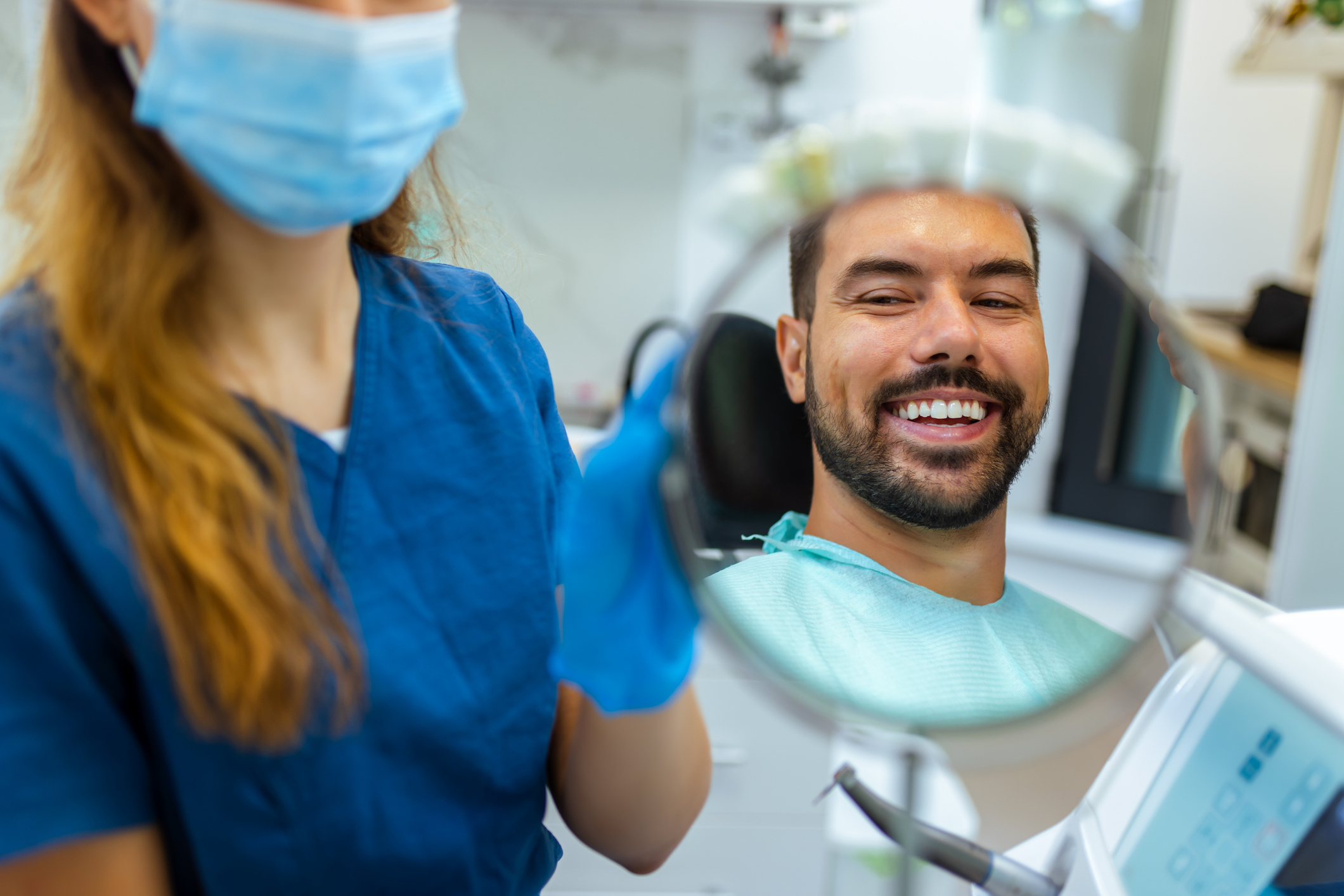
Dental providers specializing in treating patients with high gag reflexes utilize a gag-suppression protocol, combining digital intraoral scanning to avoid impressions, topical pharyngeal desensitization, and sedation. Clinical evidence supports that Idexmedetomidine for dental patients with anxiety eliminates exaggerated gag reflexes [1] (Reshetnikov et al., 2017). St. Matthew’s Family Dental in Louisville specializes in these techniques to ensure patients can receive care without physical discomfort or involuntary gagging.
For many Louisville patients, a high gag reflex is a physiological mismatch. Your glossopharyngeal nerve is designed to protect your airway, but in the dental chair, the nerve can become hypersensitive. When a dental mirror or X-ray sensor touches specific trigger zones on the back of your tongue or soft palate, your brainstem triggers an involuntary contraction of the throat muscles. At St. Matthew’s Family Dental, we do not treat this as a psychological issue; we treat it as a neurological loop that needs resetting. By identifying whether your trigger is somatogenic or psychogenic, Dr. Bevilacqua can customize your care. For somatogenic patients who physically gag, we focus on desensitizing the nerve endings. For those whose psychogenic gag reflex is triggered by anxiety, we focus on calming the nervous system before beginning treatment.
Comparing gag reflex management techniques
Method | Trigger addressed | Comfort level | Best for |
Digital scanning | Physical bulk | High | Crowns and bridges |
Topical desensitization | Surface sensitivity | High | X-rays |
Nitrous oxide | Muscle tension | High | Deep cleanings |
Traditional putty | All triggers | Low | Dental impressions |
The most common horror story for patients with high gag reflexes involves the traditional dental impression tray. Sitting for three to five minutes with a heavy, cold putty in your mouth can trigger a gag reflex. We have eliminated this step for almost all restorative procedures at our office near Mall St. Matthews. Instead of putty, our team uses a high-speed digital intraoral scanner. This wand-like device captures thousands of images per second to create a 3D map of your smile. Because the scanner is small and does not touch the trigger zones of the palate, most patients find this method of impressions comfortable. If you do feel a tickle, we can stop the scan instantly, let you take a breath, and resume exactly where we left off. This technology is not just a luxury but the difference between getting a crown and avoiding the dentist for years.
Sometimes, the gag reflex is so sensitive that even a standard cleaning feels impossible. In these cases, we utilize a specialized topical desensitization protocol. Before your hygienist begins, a professional-grade numbing spray or gel is applied to the posterior third of the tongue and the soft palate. Clinical evidence supports that mucoadhesive gels with 2% lidocaine, tannic acid, or zinc acetate decrease the gag reflex in dental patients [2] (Nikkerdar et al., 2024). This technique stops the sensory receptors that send a signal to the brain, triggering you to gag. This numbing protocol feels similar to a sore-throat lozenge, but the clinical strength is much higher. By temporarily quieting these nerves, we can perform thorough cleanings and deep scaling without your throat muscles triggering a gag response. For Louisville professionals who need to get back to a meeting downtown, this topical approach is ideal since the effect wears off quickly.
There is a direct link between mouth breathing and the gag reflex. When you feel a gag coming on, your instinct is to breathe through your mouth, which actually makes the reflex worse. At St. Matthew’s Family Dental, we coach our patients on nasal breathing techniques, but we often use Nitrous Oxide as a physical aid. Nitrous oxide does more than just make you feel relaxed; it physically relaxes the smooth muscles of the throat and significantly reduces the gag response. Medical literature supports that nitrous oxide reduces the hypersensitive gag reflex [3] (De Veaux et al., 2016). By breathing a controlled mix of oxygen and nitrous through a small nose mask, you are forced to breathe through your nose,bypassing the throat triggers entirely. Because the gas clears your system in minutes, you can drive yourself home to the East End immediately after your appointment, feeling refreshed rather than exhausted from trying to prevent the reflex.
Living with an unmanaged gag reflex is expensive. Many patients in Louisville admit they have skipped years of cleanings because they were embarrassed or afraid of gagging. This leads to the dental crisis cycle, where small, treatable cavities become expensive root canal treatments or extractions. By choosing a dentist who specializes in reflex management, you are investing in prevention. Our gag-suppression protocol allows us to catch decay when cavities are small in size. Furthermore, because we can keep you comfortable, we can often perform block appointments. This means Dr. Bevilacqua can complete multiple fillings or scans in a single visit, saving you from multiple commutes through Shelbyville Road traffic. We move you from emergency-only care to a maintenance lifestyle where your smile is always camera-ready.
Yes. In our Louisville office, we use digital sensors that are smaller and more rounded than traditional film. We can also use techniques or a topical numbing spray on the soft palate to temporarily calm the nerves.
We establish a stop signal before beginning. At St. Matthew’s Family Dental, you are in control. If you feel the reflex building, we stop immediately, let you rinse with cold water, and wait until you are ready to continue.
Placing a small amount of salt on the back of the tongue can overload your sensory receptors, momentarily distracting the brain from the gag trigger. We often use this as a quick, natural hack for our Louisville patients during brief procedures.
[1] Reshetnikov, A. P., Kasatkin, A. A., Urakov, A. L., & Baimurzin, D. Y. (2017). Management of exaggerated gag reflex in dental patients using intravenous sedation with dexmedetomidine. Dental research journal, 14(5), 356–358. https://doi.org/10.4103/1735-3327.215967
[2] Nikkerdar, N., Seyedi, H., Mirzaeei, S., Safari-Faramani, R., & Golshah, A. (2024). Comparative effects of three mucoadhesive gels containing lidocaine, zinc acetate, and tannic acid on the gag reflex of dental patients: a randomized double-blind clinical trial. BMC oral health, 24(1), 1442. https://doi.org/10.1186/s12903-024-05248-9
[3] De Veaux, C. K., Montagnese, T. A., Heima, M., Aminoshariae, A., & Mickel, A. (2016). The Effect of Various Concentrations of Nitrous Oxide and Oxygen on the Hypersensitive Gag Reflex. Anesthesia progress, 63(4), 181–184. https://doi.org/10.2344/15-00039.1